


01 June 2026
The map says “Build here.” Military Airspace says “You can’t.”
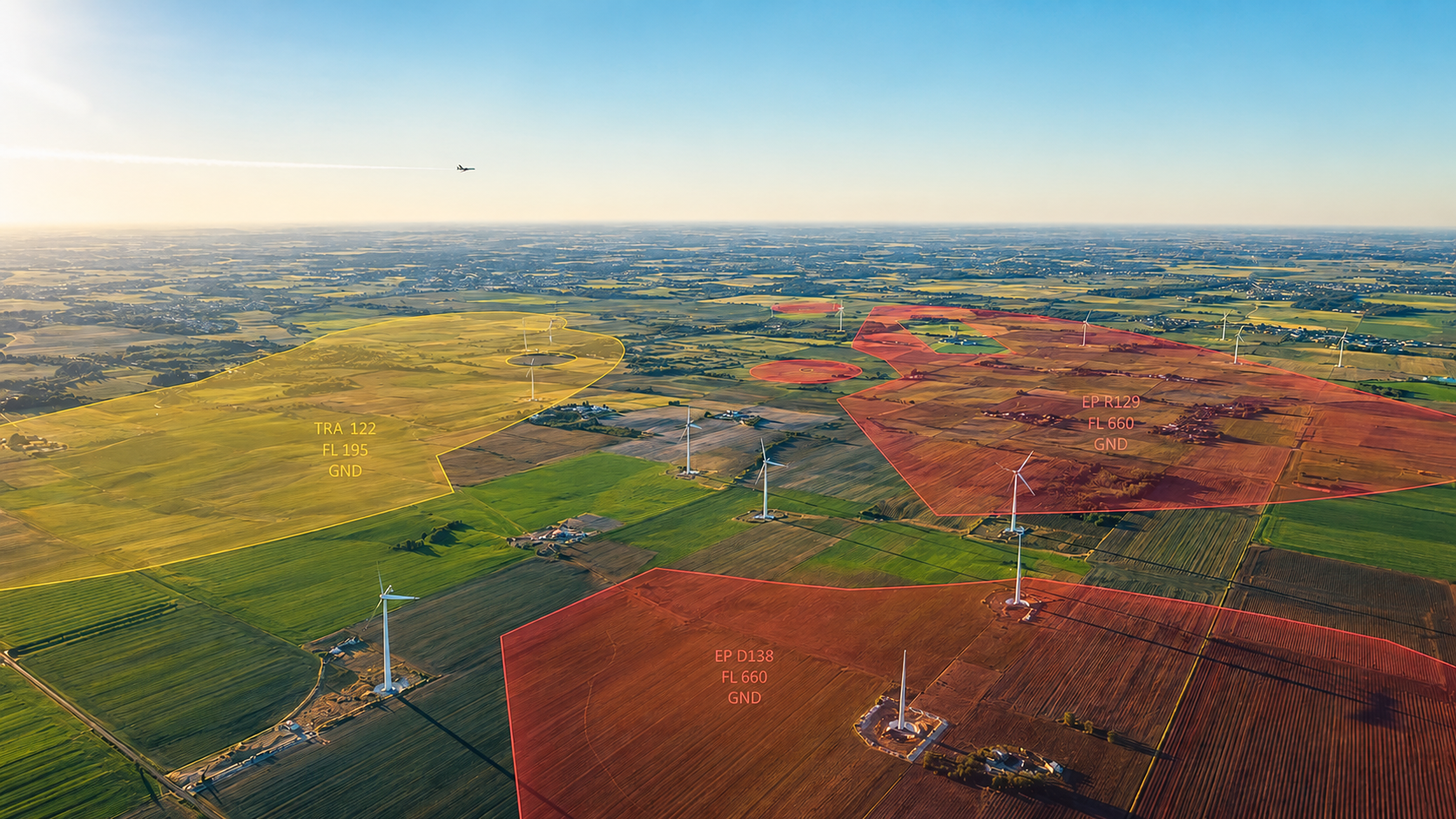
A few months ago, the Polish government unveiled the widely publicized Onshore Wind Energy Potential Map, a tool designed to direct wind energy development to areas that meet the technical and spatial criteria for wind turbines. The map identifies 1,378 municipalities with at least one hectare of land suitable for wind development. Narrow the list to municipalities offering at least 50 hectares, roughly the minimum needed for a commercially viable wind farm, and 923 municipalities remain. At first glance, it looks like a promising starting point.
The problem begins when another map is laid over it: military airspace zones.
A significant share of municipalities with wind potential lie partially or entirely within military aviation zones that, in practice, often result in developers receiving a military veto during the planning process, even after they have reached agreement with local authorities on zoning plans.
It appears that one part of the public administration was working on identifying areas suitable for wind development, while the military, independently and in parallel, significantly expanded aviation zones. The result is an increasingly visible conflict between two state policies, with wind energy projects caught in the middle.
Yet data from 2024 suggest that this issue deserves a closer look: many of these airspace zones are used only occasionally, and some not at all.
Numbers That Cannot Be Ignored
The 2024 Annual Report published by the Polish Air Navigation Services Agency (PANSA) provides detailed information on the actual use of military airspace in Poland. The data covers three categories of airspace:
- TSA (Temporary Segregated Areas)
- TRA (Temporary Reserved Areas)
- MRT (Military Routes)
The results are striking.
Among 122 TSA zones analyzed, average utilization reached only 24.5%. The median was even lower at 19.3%, meaning that half of all TSA zones were active for less than one fifth of the time they were reserved. Nearly one in five TSA zones can be classified as effectively dormant, with utilization below 5%.
Military routes fare even worse. Among 151 MRT routes, 40% recorded activation rates between 0% and 5%. The median utilization was just 10.4%, and one in five routes was not activated a single time throughout the year. The average of 18.6% is driven upward by a small number of heavily used routes. The typical military route remains unused for most of the year.
TRA zones show greater variation. Average utilization reached 34.5%, while the median stood at 28.1%. A handful of zones likely located around major training areas and military airbases, recorded utilization rates of 88–97%. However, 28% of TRA zones also fall into the dormant or near-dormant category.
Taken together, the data reveals a simple fact: most reserved military airspace in Poland remains unused for most of the year.
A Planning Contradiction
Combining PANSA’s airspace management data with the Wind Energy Potential Map reveals a picture that should give policymakers pause.
Of the 923 municipalities identified as having more than 50 hectares of suitable wind development land, 778 municipalities, or 84%, are affected by at least one military aviation zone. Only 145 municipalities combine significant wind potential and face no aviation restrictions.
The overlap is extensive:
- 368 municipalities fall within MRT and CTR/MCTR zones.
- 582 municipalities are affected by TSA zones.
- 558 municipalities are affected by TRA zones.
Multiple restrictions are the norm rather than the exception. As many as 200 municipalities lie simultaneously within all three categories.
This is not an isolated planning conflict. It is a systemic contradiction between two public policy instruments, one that identifies locations suitable for wind development and another that effectively prohibits it, regardless of whether the airspace above those municipalities is actually being used.
Reservation Is Not the Same as Activity
One critical distinction is often overlooked in discussions about wind energy and military airspace.
Military zones are not comparable to highways operating at full capacity around the clock. They are more like parking spaces reserved exclusively for a single company. Even if the vehicles turn up only a few times a year, the space remains unavailable to everyone else.
Within Poland’s Airspace Management (ASM) system, military authorities reserve zones well in advance and often for extended periods. Actual activation, when the airspace is genuinely used and unavailable to civilian traffic, may be dramatically shorter than the reservation period.
PANSA’s report documents this gap.
Some TSA zones are formally reserved for the entire year—8,760 hours—while being activated for less than 1% of that time. Legally, the restriction exists every day of the year. Operationally, military aircraft may use the zone for only a handful of days.
Yet wind turbines remain prohibited.
What About the Turbines Already There?
An equally important observation concerns existing wind farms.
Today, approximately 1,000 operational wind turbines are located within MRT, MCTR and CTR zones. Another 2,500 turbines operate within TSA and TRA zones. After accounting for overlapping areas, roughly 3,000 turbines—around one third of all turbines operating in Poland—coexist with military airspace restrictions.
This raises two important questions.
First, it challenges the notion that wind turbines and military aviation are inherently incompatible. If thousands of turbines already operate within these zones, coexistence is clearly possible.
Second, it raises questions of consistency. Why were turbines built before the current airspace boundaries were accepted, while new projects are increasingly rejected? Have these airspace boundaries ever been reassessed against actual flight activity and operational requirements? Or have some zones become broader than necessary, with no consideration of the consequences for energy development?
Publicly available documents provide no clear answers.
What Does the Data Show?
To better understand the relationship between wind potential and military activity, we matched the Wind Energy Potential Map with PANSA’s 2024 utilization data and analyzed municipalities individually.
The study covered 903 municipalities with more than 50 hectares of wind potential. For 702 of them, specific airspace zones and utilization levels could be clearly identified.
The findings are revealing.
Nearly one-third of municipalities are affected exclusively by low-activity airspace zones.
Specifically, 211 municipalities, 30% of the sample, are covered only by zones where even the most heavily used zone recorded activation below 20%.
These municipalities are not being constrained by intensive flight activity.
They are being constrained by reservations.
At the other end of the spectrum, only 81 municipalities, 11.5% of the sample, are affected by zones with utilization rates above 80%, the cases where military objections appear most clearly justified by operational requirements.
For the remaining 88.5%, the relationship between reserved and actually used airspace deserves closer examination.
Zero activity is not uncommon.
Among municipalities with more than 300 hectares of wind potential are several covered by airspace zones that recorded no military activity whatsoever during 2024. Dębnica Kaszubska, Nowe Miasto nad Pilicą, Karnice, Środa Wielkopolska and Trzebielino all appear on the government’s Wind Energy Potential Map as promising locations for wind development.
Yet all lie beneath airspace zones with 0% activation. No military flights. Not a single hour of activity. And still, wind projects face restrictions.
Moreover, individual dormant zones affect multiple municipalities simultaneously. Zone EPTS408, which recorded zero activation hours in 2024, covers 13 municipalities with wind potential. Zones EPTR65B and EPTR716, also inactive, affect 11 and 9 municipalities respectively. Two military routes, EPMRT021 and EPMRT082, were never activated during the year yet influence nearly 20 municipalities combined.
This is not a random coincidence. It is a specific list of zones whose review, reclassification or boundary adjustment could unlock dozens of viable wind development locations.
What Should Be Done?
This analysis is not an argument against the military or against airspace management.
National security is paramount, and no reasonable stakeholder advocates eliminating military airspace protections for the sake of wind farms.
The argument is much simpler: Data should matter.
Today, the system often follows a predictable pattern:
- A municipality appears on the government’s Wind Energy Potential Map.
- A developer enters a costly, multi-year planning process.
- During consultations, military authorities reject the project due to an airspace restriction.
- Public PANSA data show that the relevant zone remains inactive for most of the year.
- The project is abandoned, municipalities lose future tax revenues, and Poland falls further behind its renewable energy targets.
Addressing this issue does not require a major regulatory overhaul.
Three practical changes could significantly improve the process:
- Require actual airspace utilization data to be considered during renewable energy permitting procedures.
- Conduct periodic reviews of zones with activation rates below 5% to assess whether their current boundaries remain operationally justified.
- Require military objections to reference specific aviation activities rather than relying solely on the existence of a reserved zone.
Airspace is a public resource. Data on its use has been publicly available for years.
What has been missing is a comparison between how that airspace is actually used and how it affects the municipalities identified as key locations for Poland’s energy transition.
That comparison can now be made.
The analysis is based on data from the 2024 Annual Report – Air Traffic in the Warsaw FIR, ASM Strategic Planning Department (PANSA), pp. 39–51, as well as data from the Onshore Wind Energy Potential Map. The statistical analysis covers 122 TSA zones, 492 TRA zones, and 151 MRT routes.
Grzegorz Nowak
Senior GIS Analyst
Tundra Advisory
